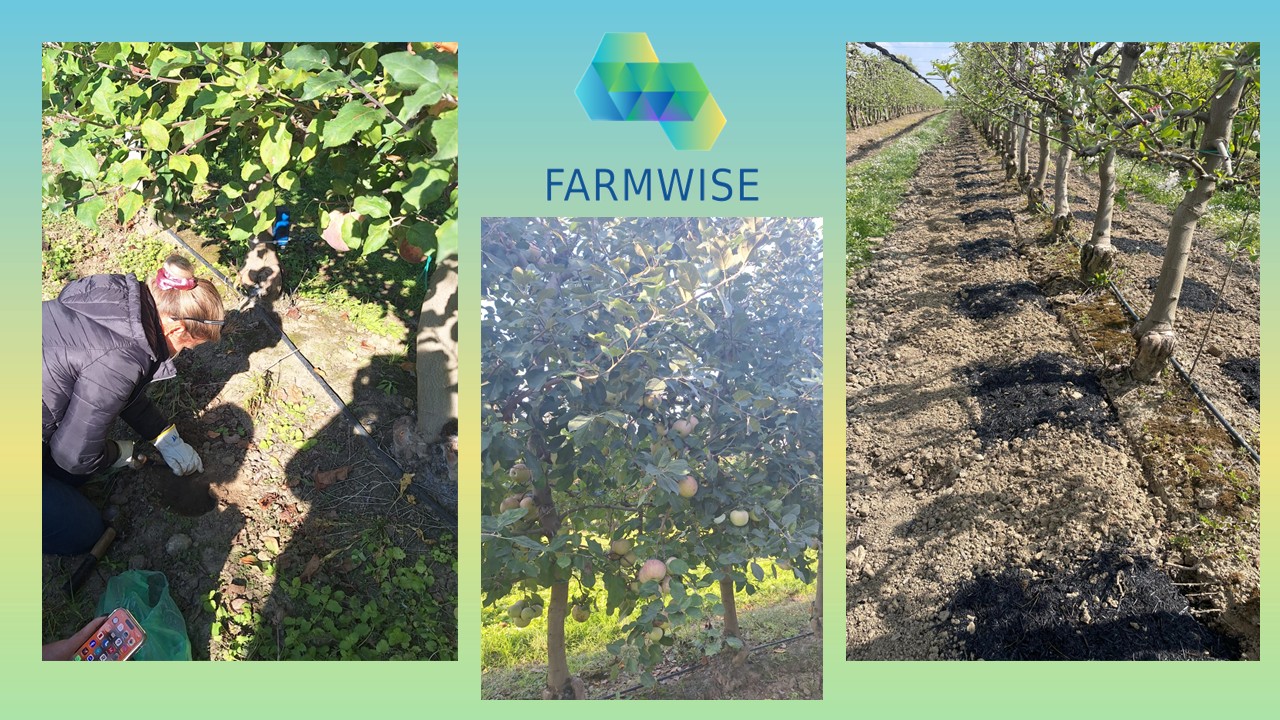
A significant new phase of the Italian FARMWISE case study is underway at Acqua Campus, where technicians from the experimental centre — together with Professor Agnieszka Medyńska-Juraszek from the University of Environmental and Life Sciences in Wrocław (UPWr), Poland — have launched a detailed investigation into the use of biochar in orchard systems.
This work represents an important milestone in FARMWISE’s ongoing effort to test nature-based, resource-efficient, and water-smart agricultural solutions under real field conditions.
🌱 Field Trial in a Fuji Apple Orchard: Integrating Science and Practice
The latest activities took place in a Fuji apple orchard, where a structured field trial was initiated in April 2025. Biochar was incorporated along the tree rows with the dual aim of evaluating its:
- Agronomic performance
- Environmental impacts
To capture the full picture of how biochar interacts with orchard systems, the team combined:
- Comprehensive soil sampling
- An experimental fruit harvest, designed to assess effects on yield, fruit quality and productivity
- On-site measurements to document soil moisture and physical changes
This integrated approach allows the researchers to connect physico-chemical soil parameters with tangible agronomic outcomes, providing a robust evaluation of biochar’s effectiveness in orchard management.
🔬 Laboratory Work and Cross-Country Collaboration
Soil samples collected from the orchard have been shipped to UPWr’s advanced laboratory facilities, where they will undergo detailed analysis in collaboration with Acqua Campus’ researchers.
A particular focus will be placed on:
- Changes in soil water retention capacity
- Soil structure and porosity
- Carbon dynamics and nutrient interactions
By combining laboratory precision with field-level measurements, FARMWISE is generating high-quality data that can support long-term modelling, scenario development, and evidence-based recommendations for Mediterranean and temperate orchard systems.
🌍 What Is Biochar — and Why Does FARMWISE Study It?
Biochar is a carbon-rich material produced through the pyrolysis of residual plant biomass. Within FARMWISE, it is being investigated as a promising circular and climate-beneficial soil amendment because it can:
- Improve soil structure and water-holding capacity
- Increase organic matter content in degraded soils
- Help purify water through natural filtration properties
- Enhance soil fertility and root-zone stability
- Support carbon sequestration, locking carbon in the soil for decades
- Reinforce circularity by reusing agricultural waste materials
For regions facing water scarcity — including parts of Italy — biochar is an increasingly valuable tool for making soils more resilient to drought and less dependent on irrigation.
🧪 Research Partners and Their Roles in FARMWISE
Acqua Campus (Italy)
Acqua Campus is a leading experimental facility specialising in innovative irrigation, field experimentation, and water-saving technologies.
Within FARMWISE, it hosts the Italian living lab, offering real-world test sites where new soil and water innovations can be validated under authentic farming conditions.
University of Environmental and Life Sciences in Wrocław (UPWr, Poland)
UPWr contributes cutting-edge expertise in soil science, organic amendments, carbon cycling, and climate-smart land management.
Their laboratories support FARMWISE by analysing soil physical and chemical properties and assessing how innovations influence water availability, soil function, and long-term resilience.
Together, the organisations provide a model of scientific excellence + applied field expertise, ensuring that FARMWISE solutions are both innovative and practical.
🌾 Why This Work Matters for FARMWISE
This activity is a core component of FARMWISE’s broader strategy to develop:
- Smart water management tools
- Circular soil solutions
- Evidence-based recommendations for farmers and regional authorities
- Resilience strategies that reflect Europe’s increasingly variable climate
The Italian biochar study offers real-world insights into:
- How soil amendments can support water-smart orchard systems
- The role of carbon-rich materials in improving soil function
- The potential for circular biomass use to reduce environmental impact
- How innovations behave under Mediterranean climate pressures
Results from this investigation will feed directly into FARMWISE’s cross-regional modelling and stakeholder tools, supporting better decisions for farmers, irrigation authorities, and policymakers.
📌 Next Steps
Over the coming months, UPWr will complete the laboratory analyses, and the FARMWISE team will integrate these findings with:
- Orchard productivity data
- Soil moisture records
- On-farm qualitative observations
A comprehensive summary will be made available through future FARMWISE publications, workshops and stakeholder engagement activities.