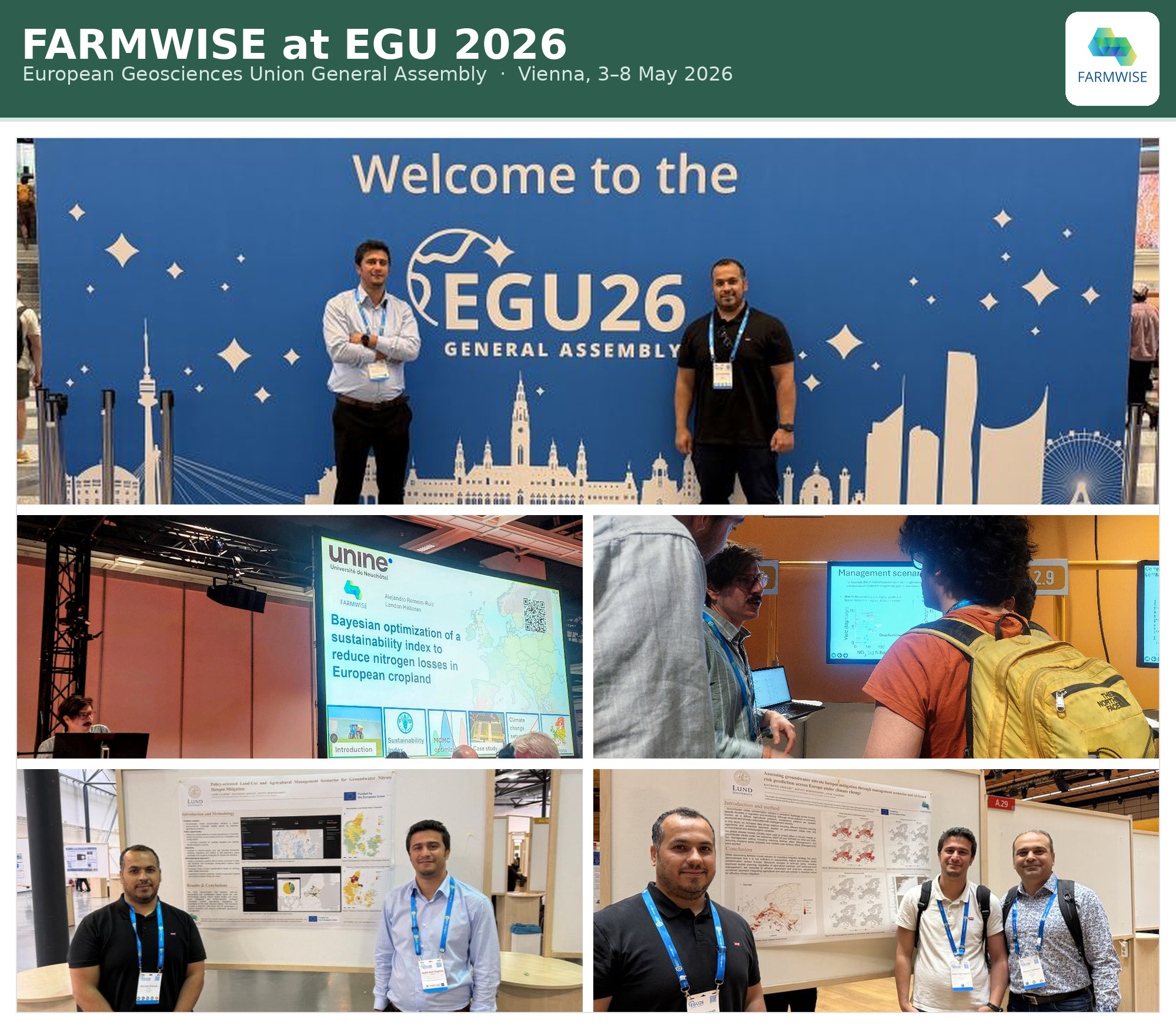
Some scientific problems are easier to find than to fix. Nitrate pollution in groundwater is one of them: diffuse, stubborn, and deeply bound up with the way food is grown across Europe. It can be mapped. It can be measured. But deciding what to do about it, where to act first, and how to balance agricultural production with water protection is a more awkward business altogether.
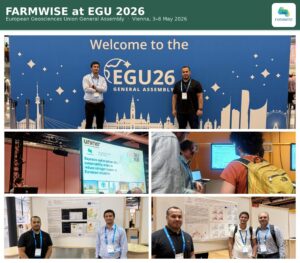
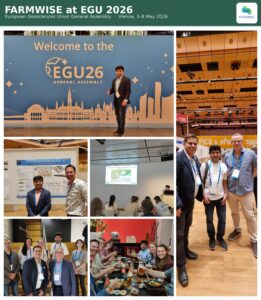
That awkward business was very much in view at the European Geosciences Union General Assembly 2026, held in Vienna this May. FARMWISE researchers travelled to Austria with a body of work that, taken together, showed the project’s central concerns in unusually clear form: how to keep nitrogen out of Europe’s groundwater, how to design agricultural policy that still makes sense under the climate of 2050, and how to make better use of the data already coming from fields, models and satellites.
EGU is one of the two largest gatherings of geoscientists in the world, and FARMWISE did not appear there as a single dot on the programme. Its contributions stretched across institutions, methods and sessions, from Lund University and the University of Neuchâtel to Wageningen University and the University of Bologna. The result was not a neatly packaged showcase, and all the better for it. It was a scattered but revealing picture of a consortium working on the same problem from several directions.
Designing policy, not just mapping risk
The largest single contribution came from Lund University, which brought three pieces of work to the assembly. Two of them form a natural pair, both circling the problem of nitrate hotspots in groundwater: the places where agricultural nitrogen losses become concentrated enough to threaten water quality and force difficult decisions about land use, farming practice and regulation.
The first, Policy-oriented Land-Use and Agricultural Management Scenarios for Groundwater Nitrate Hotspot Mitigation, was presented by Amir Naghibi with Kourosh Ahmadi and Ronny Berndtsson. It is best understood as a decision-support engine. In plain terms, it helps regulators, municipalities and water utilities test different combinations of land-use and agricultural measures, compare one intervention strategy with another, and explain why some areas may need more targeted action than others within groundwater nitrate protection zones.
That last point matters. Environmental protection is not only a question of knowing where the problem is. It is also a question of being able to justify action fairly and transparently, especially when one farm, municipality or region may be asked to do something different from its neighbour. The work is therefore built as much for the awkward politics of environmental protection as for the science.
Its companion contribution, Assessing groundwater nitrate hotspot mitigation through management scenarios and AI-based risk prediction across Europe under climate change, led by Kourosh Ahmadi with Ronny Berndtsson and Amir Naghibi, takes the question up to the European scale and forward in time. Rather than stopping at a risk map, it asks which mitigation strategies still hold up under 2050 climate projections. Extensification, wetland restoration and fertiliser caps may all have a place, but their usefulness will depend on where they are applied and how future conditions unfold.
The useful move here is from description to decision. It is one thing to say where nitrate risks are likely to be high. It is another to ask what can sensibly be done, under which future climate conditions, and where action should be prioritised across the EU.
Lund’s third contribution looked skyward. DefoEye, presented by Alireza Taheri Dehkordi with Hossein Hashemi and Amir Naghibi, is an end-to-end, Python-based, open-source toolkit for time-series InSAR analysis of Sentinel-1 satellite data. InSAR, or interferometric synthetic aperture radar, is a satellite method that can detect tiny changes in the land surface over time. It is useful, but not always friendly to the uninitiated. DefoEye is an attempt to lower that barrier, making the processing more approachable and the technique easier to use.
Another angle on nitrogen losses
FARMWISE’s presence in Vienna also extended to Switzerland. From the University of Neuchâtel, Alejandro Romero-Ruiz presented Bayesian optimization of a sustainability index to reduce nitrogen losses in European cropland, with Landon Halloran, in one of EGU’s interactive PICO sessions.
A PICO session is not the classic stand-at-a-podium format. Presenters give a short pitch on screen, then move into one-to-one discussion at a touchscreen. It is a fitting format for work that is not just about producing a number, but about weighing competing demands. Bayesian optimization is a way of searching efficiently for better solutions when testing every possible option would be impractical. Here, the aim is to explore how nitrogen losses from European cropland can be reduced while still considering the wider sustainability balance.
Again, the practical question is not simply “how do we reduce nitrogen?” It is “how do we reduce nitrogen without pretending that agriculture, water quality, productivity and environmental protection can be dealt with in separate boxes?”
A wider FARMWISE presence
These were not the project’s only moments in Vienna. Wageningen University was also among the FARMWISE partners presenting, with Jelte de Bruin’s work on simulating water management strategies under future climatic extremes, while colleagues from the University of Bologna also featured on the programme. Across talks, posters and PICO screens, FARMWISE appeared in discussions about agriculture, water, climate pressure, satellite data and the tools that help turn evidence into decisions.
What unites this spread of work is not a single session or a shared slot in the timetable. It is a common concern with evidence that survives contact with reality. Groundwater protection is not helped much by elegant models that cannot be used, or by risk maps that stop just short of the question everyone eventually has to ask: what now?
EGU 2026 gave FARMWISE researchers a chance to test their work in front of their peers and, just as importantly, to see how the different strands of the project speak to one another. From nitrogen hotspots to future climates, from land-use policy to satellite monitoring, the week showed a project steadily working its way towards the difficult middle ground where science, policy and practical decision-making have to meet.
FARMWISE thanks everyone who represented the project in Vienna, and the colleagues who helped bring the consortium’s many contributions together so that none slipped quietly through the conference machinery unnoticed.
FARMWISE contributions at EGU General Assembly 2026, Vienna, 3–8 May 2026:
- Naghibi, A., Ahmadi, K., Berndtsson, R. — Policy-oriented Land-Use and Agricultural Management Scenarios for Groundwater Nitrate Hotspot Mitigation. EGU26-4407
- Ahmadi, K., Berndtsson, R., Naghibi, A. — Assessing groundwater nitrate hotspot mitigation through management scenarios and AI-based risk prediction across Europe under climate change. EGU26-19546
- Taheri Dehkordi, A., Hashemi, H., Naghibi, A. — DefoEye: An End-to-End Python-Based Toolkit for Time-Series InSAR Analysis of Sentinel-1 Data.
- Romero-Ruiz, A., Halloran, L. — Bayesian optimization of a sustainability index to reduce nitrogen losses in European cropland (PICO). EGU26-17734
- de Bruin, J., et al. — Simulating agricultural water management strategies under future climatic extremes. EGU26-19624
- Lavrnic, S., et al. — EGU26-12108