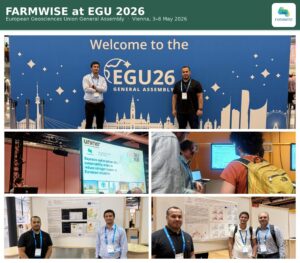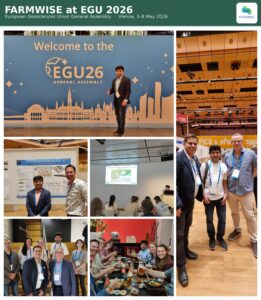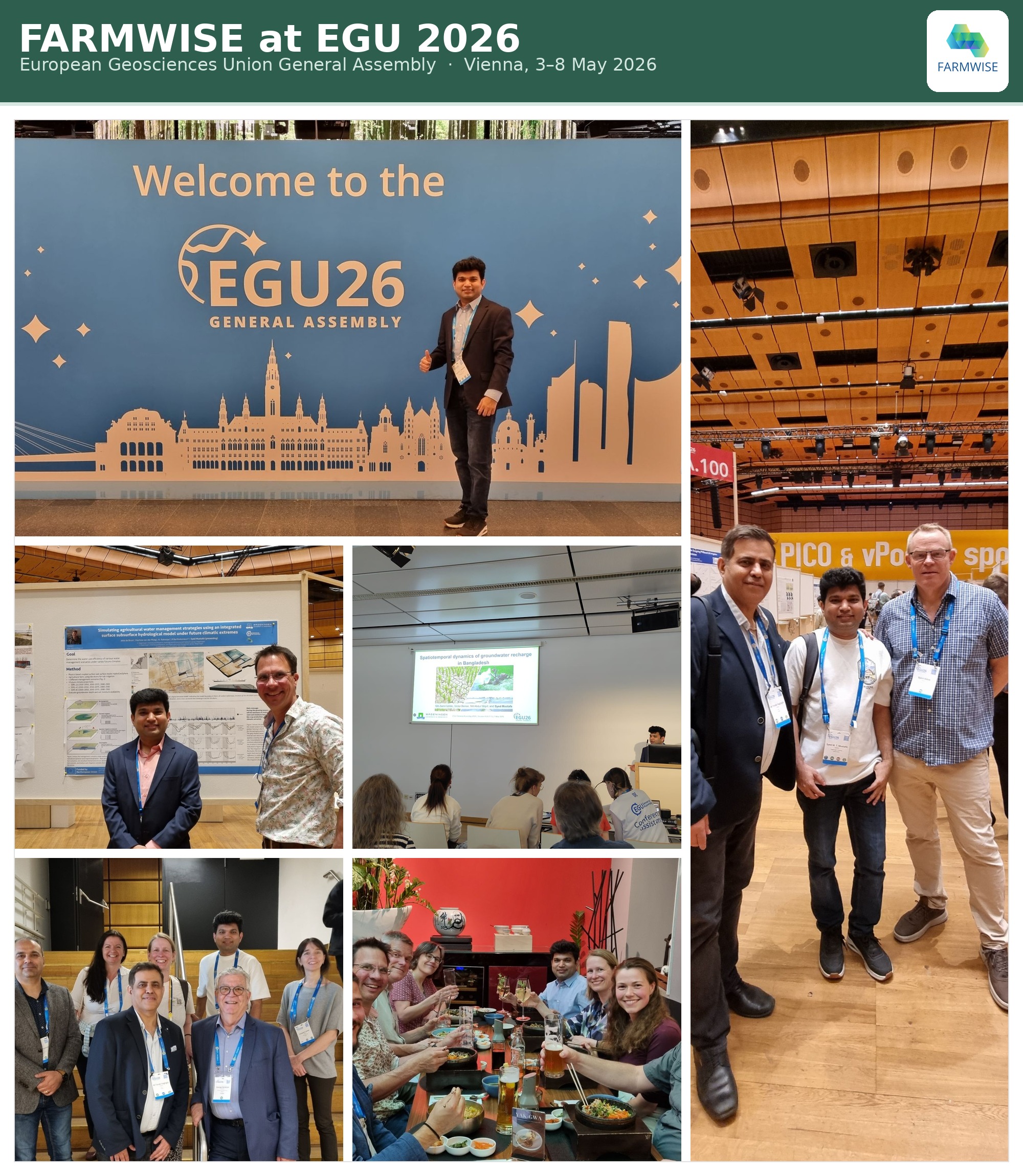
When you have spent months building a model and you finally have results worth sharing, the natural reward is to stand up in front of your peers and present them yourself. This year, one of Wageningen University’s hydrogeologists could not make that journey to Vienna, so FARMWISE partner Syed Mustafa carried his work there for him.
At the European Geosciences Union (EGU) General Assembly 2026, held in Vienna from 3 to 8 May, Syed Mustafa took to the floor on behalf of a member of his team. Mustafa, an Assistant professor in Hydrogeology at the Hydrology and Environmental Hydraulics group at WUR and Co-Principal Investigator on the EU Horizon-funded FARMWISE project, presented the research of postdoctoral researcher Jelte de Bruin, who was unable to attend in person. “As a supervisor,” he reflected afterwards, “I couldn’t be prouder to share their impactful research.”
It is a small act of academic generosity that says a good deal about how the FARMWISE consortium works, and the science he brought to the room is squarely at the heart of what the project is trying to achieve.
The question the research is chasing
Farmers are being handed more and more uncertainty. As temperature and rainfall patterns shift and prolonged spells of heat and drought become more frequent, the growing season itself becomes harder to predict, both in how long it lasts and in the conditions a crop will meet along the way. And of all the variables a farmer cannot control, the availability of water at the right moment is among the most decisive for a healthy yield.
The work de Bruin presented, drawn from the FARMWISE project, sets out to answer a practical question: which water management strategies will actually help farmers weather those future extremes? Three approaches were put to the test: traditional sprinkler irrigation, subirrigation, and a combination of controlled subirrigation with tile drainage.
To probe them, the team built a three-dimensional, physics-based model of an experimental field in the Netherlands using HydroGeoSphere, a tool that simulates surface water and groundwater as a single connected system. The field is no abstraction: it carries a real controlled-drainage and subirrigation system that is actively being monitored, and that live data was used to calibrate the model so that it faithfully reproduces both the natural rise and fall of groundwater and the behaviour of the engineered system.
With the model trusted, the team then pushed it into the future by running each management strategy against climate projections drawn from the SSP1-2.6, SSP2-4.5 and SSP5-8.5 scenarios across three time horizons, and watching how hydraulic head and soil moisture responded. Those results are now being analysed to establish which strategies hold up best under which climates. It is the kind of patient, evidence-first work that turns a good idea about adaptation into advice a farmer can actually use.
The study was a genuinely collaborative effort, authored by Jelte de Bruin, Martine van der Ploeg, Nikola Rakonjac, Ruud Bartholomeus, Janine de Wit and Syed Mustafa himself, spanning Wageningen’s Hydrology and Environmental Hydraulics and Soil Physics and Land Management groups together with the KWR Water Research Institute.
The wider value of being in the room
For all the science on the programme, Mustafa warmly praised the type of gathering like EGU offers: the chance to meet geoscientists from around the world and to reconnect with current and former colleagues. The FARMWISE family was well represented among them: Martine van der Ploeg, Ruud Bartholomeus and Nikola Rakonjac from Wageningen, alongside familiar faces from across the consortium including Landon Halloran and Alejandro Romero-Ruiz from Neuchâtel, and Ali Torabi Haghighi, Sahand Ghadimi, Kourosh Ahmadi and Hossein Hashemi from the project’s wider network. It is at these meetings, in the corridors as much as the conference rooms, that the connections that strengthen a project like FARMWISE are made and reinforced
The week in Vienna was, by Mustafa’s own account, filled with new insights, engaging discussions and valuable networking. For FARMWISE, it was a chance to show that the project’s research into climate-resilient water management is maturing, and to do so, fittingly, as a team.
The presentation, “Simulating agricultural water management strategies using an integrated surface-subsurface hydrological model under future climatic extremes” (de Bruin, J., van der Ploeg, M., Rakonjac, N., Bartholomeus, R., de Wit, J., and Mustafa, S.), was given at EGU General Assembly 2026, Vienna, Austria, EGU26-19624. https://doi.org/10.5194/egusphere-egu26-19624
Syed Mustafa is Assistant Professor in Hydrogeology at Wageningen University & Research and a Co-Principal Investigator of the FARMWISE project. Profile