Questions FARMWISE shares with the EU CAP Network
Every so often a newsletter lands in the inbox that feels less like external news and more like a mirror held up to your own work. The EU CAP Network’s May edition was one of those. Read it with FARMWISE concerns in mind and the same handful of questions surface again and again: how do rural areas adapt to water stress and a climate of extremes? How do sensing technologies earn their place in everyday farm decisions? And how can the green ambitions of Europe’s farm policy be judged by what they actually deliver on the ground?.
It is worth pausing on a few of those questions, because each one closely relates to something FARMWISE is trying to do.
Water challenges, CAP solutions
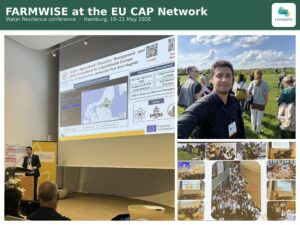
The centrepiece is a gathering FARMWISE knows from the inside, because a number of our project partners were in the room. The newsletter’s lead item, “Water challenges, CAP solutions”, makes the argument that to withstand climate extremes, rural areas need systemic and transformative change in how they manage water and land, and points to the many projects, initiatives and CAP interventions already showing the way. Behind it sits the EU CAP Network’s water resilience conference, held in Hamburg from the 19th to the 21st of May, where around 250 farmers, foresters, advisers and researchers from across Europe gathered, and where Assoc. Professor Amir Naghibi of Lund University delivered the FARMWISE project pitch. (We told that story separately in Drawing Down the Well.) The newsletter’s feature will be familiar to anyone who listened to him on that stage: changing rainfall patterns, longer dry spells and growing competition for water are already reshaping yields, farm planning and rural livelihoods, and the aim was to move practical innovations from isolated success stories into wider use.
Mario Milouchev, who directs CAP Strategic Plans work at the European Commission’s agriculture directorate, put the case plainly. “Water resilience is now a shared European challenge that requires shared European solutions,” he said, adding that the priority now is to accelerate the uptake of practical innovations that are already helping farmers strengthen resilience across the continent.
What gives the event its substance is the way it refused to treat water as a single problem with a single fix. Discussions revolved around six distinct challenges: circular water management, climate-resilient and less thirsty crops, irrigation efficiency sharpened by digital tools, nature-based solutions, soil management, and water quality and pollution. It is very nearly a map of the terrain FARMWISE works across, drawn by another hand.
From sensing to decision
If the Hamburg conference is the policy hook, a single spotlighted report is where the newsletter speaks most directly to FARMWISE’s own research. Its title alone could double as a FARMWISE mission statement: “Sensing the future: practical applications of proximal and remote sensing for farmers and advisors”. The report, drawn from an EU CAP Network workshop held in Valencia in January, sets out to demonstrate the practical, economic and social value of these technologies and, just as importantly, to confront the barriers that still keep them from being integrated into everyday farm and forestry management.
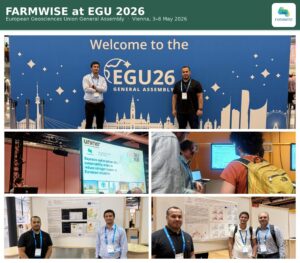
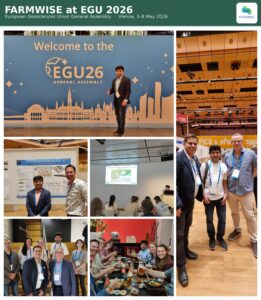
That last point is the crux. Remote sensing, which observes the land from above, and proximal sensing, which reads conditions on or near the ground, are only ever as valuable as the decisions they enable. The connecting thread runs from the satellites and soil probes themselves to the harder question of what a farmer or an adviser is actually supposed to do with the data they produce. That gap between measurement and action is just where much of FARMWISE’s work resides. It is the thinking behind the project’s Land Use Policy Simulator, which models how different land-use and crop choices might affect water quality, and behind the soil-moisture sensors, decision-support systems and radar applications Naghibi set out in Hamburg. It is also the thread running through FARMWISE’s research at the recent EGU General Assembly in Vienna, from nitrate-hotspot policy tools to satellite monitoring. Seeing the wider community work to close the same gap from the practitioner’s side is welcome confirmation that the project is asking the right questions.
Also worth reading
Three further items repay a read-through. A workshop report from Larnaca, in Cyprus, gathers the best current thinking on how to assess the green architecture of CAP Strategic Plans, the bundle of environmental conditions and incentives meant to make the policy deliver for climate and nature rather than merely promise to. Its central message is one FARMWISE would endorse: that these green instruments need to be judged by their combined effects and interactions, not picked apart and assessed one by one. A second item turns to soil, reporting on a capacity-building event in which the Network and its Evaluation Helpdesk trained Member States to explore and quantify what CAP Strategic Plans can actually do for soil health, a question of measurement as much as agronomy. And a third looks to the crops themselves: a workshop in Vienna in late April, where seventy-seven farmers, researchers, advisers and agri-businesses traded practical experience of growing alternative, less thirsty crops across Europe’s varied climates, and of finding markets for them.
None of these is a FARMWISE output, and that is rather the point. The questions that animate our project are being asked, in parallel and from a policy angle, right across the European farming community. Better evidence, used well, is what allows farmers, advisers and policymakers to make choices that hold up under pressure. On the strength of its May newsletter, that conviction is one FARMWISE and the EU CAP Network plainly share.
Further FARMWISE reading: our coverage of the project’s research at EGU 2026 in Vienna, From nitrate hotspots to hard choices: FARMWISE at EGU 2026 and Standing in for the team: FARMWISE takes its climate-resilience research to Vienna.“
Sources: EU CAP Network newsletter, May 2026, and related EU CAP Network publications, including the items “Water challenges, CAP solutions”, the spotlighted report “Sensing the future: practical applications of proximal and remote sensing for farmers and advisors” (workshop held in Valencia, 27–28 January 2026), “Assessment of the green architecture of CAP Strategic Plans” (Good Practice Workshop, Larnaca, Cyprus, 16–17 March 2026), the soil-health capacity-building event, and the workshop “Growing alternative crops for new market opportunities in a changing climate” (Vienna, 22–23 April 2026). Conference and quotation detail from the EU CAP Network press release “Water resilience high on Europe’s farming agenda” (21 May 2026); the conference “Water resilience in agriculture: innovation in practice” took place in Hamburg, Germany, 19–21 May 2026.