A new open-access study co-authored by FARMWISE researchers Alejandro Romero-Ruiz, Landon J. S. Halloran and colleagues has used a continent-scale modelling framework to investigate how soil compaction could affect European agriculture and the wider environment under future climate conditions.
Soil compaction happens when heavy agricultural machinery compresses the soil, reducing the space available for air and water to move through it. This can make it harder for crops to grow, reduce soil health, increase runoff and affect how carbon and nitrogen are stored or lost from agricultural land.
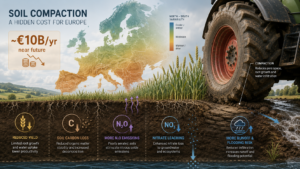
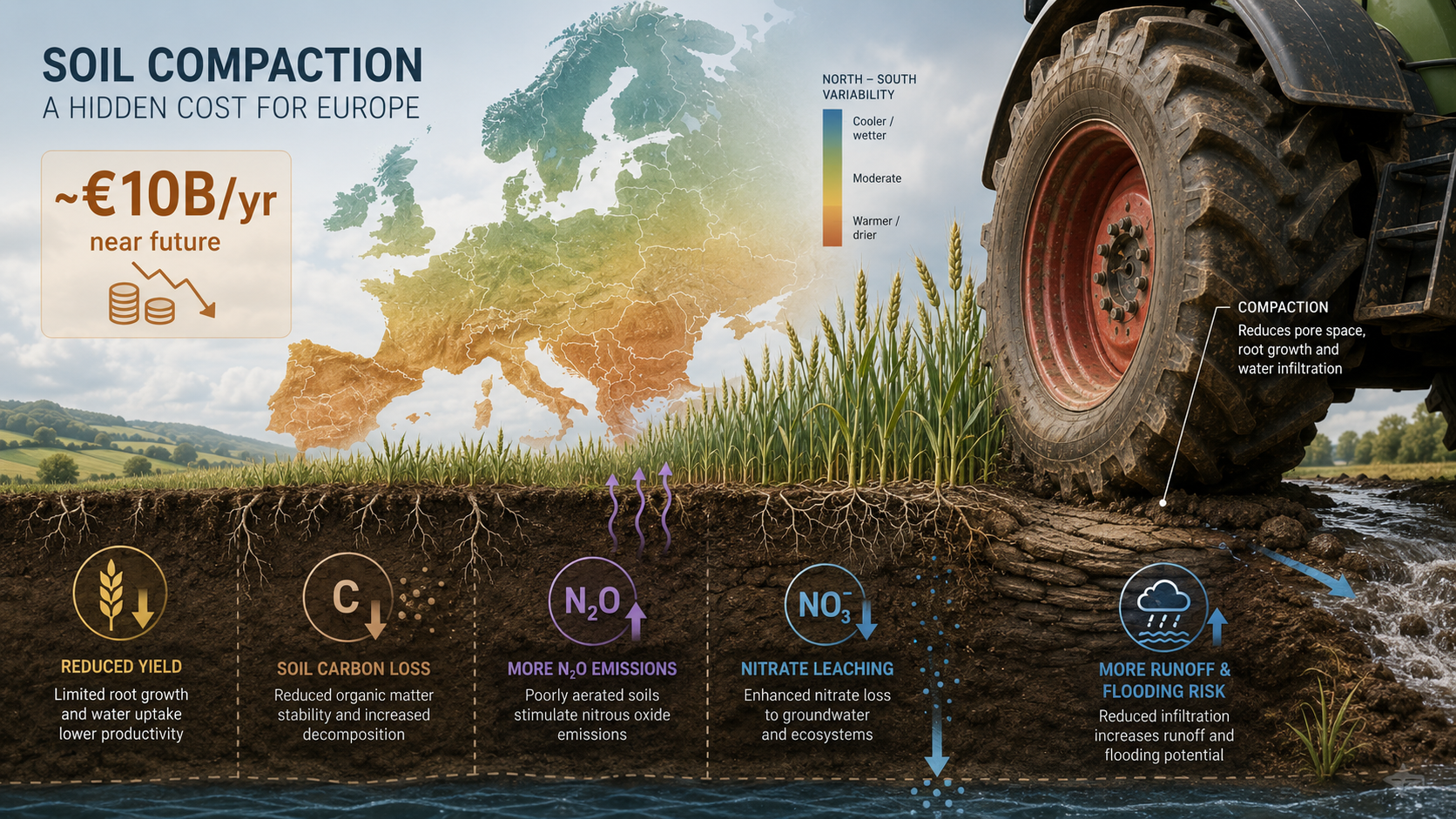
The study adapted an agri-hydrological modelling framework developed for FARMWISE to explore the future impacts of soil compaction across European cropland. The researchers focused on winter wheat, the most widespread crop in Europe, and modelled changes in crop yield, soil organic carbon, nitrous oxide emissions, nitrate leaching and surface water runoff under a high-emissions climate scenario.
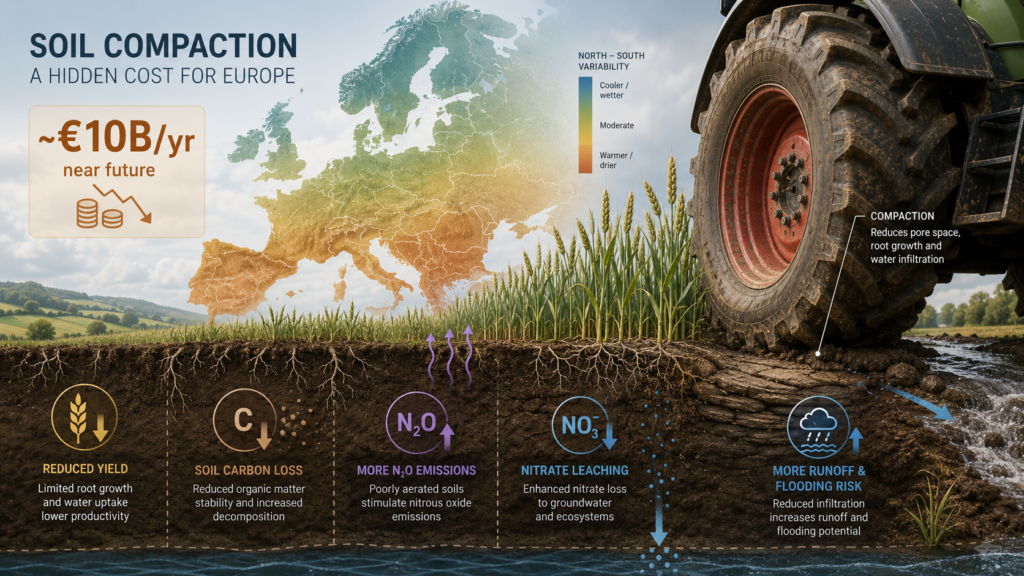
The results suggest that soil compaction could cost Europe around €10 billion per year in the near future when losses from yield, carbon, nitrogen and flooding risk are considered together. The impacts vary strongly across Europe, with clear differences between northern and southern regions and between different climate zones.
In the near future, the largest costs are linked to reduced crop yields, increased nitrous oxide emissions and soil carbon losses. By the end of the century, the picture changes. As climate change increasingly affects crop yields regardless of compaction, nitrous oxide emissions become the dominant source of compaction-related economic costs.
The study also estimates that soil compaction could add around €3 billion per year in flooding-related costs in the near future, rising slightly by the end of the century. This is linked to increased surface runoff, as compacted soils are less able to absorb and move water effectively.
The findings underline why soil structure and soil health matter for climate resilience, water management and sustainable food production. They also point to the need for practical measures to reduce compaction risks, including improved field traffic management, soil recovery practices, lower-impact machinery and policy approaches that better protect agricultural soils.
For FARMWISE, the study shows how advanced modelling can help reveal the hidden costs of soil degradation and support better decisions for sustainable agriculture, water management and environmental policy across Europe.
Access the full paper here: https://iopscience.iop.org/article/10.1088/1748-9326/ae7c8d/pdf